

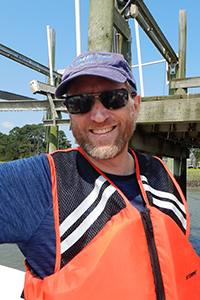
Mark Brush
Professor
Email:
[[brush]]
Phone:
(804) 684-7402
Office:
Andrews Hall 334F
Section:
Ecosystem Health
Interests:
Coastal systems ecology; Ecosystem modeling
Links:
{{https://www.vims.edu/research/units/labgroups/semp/, Systems Ecology and Modeling Program}}
Education
- B.S., Cornell University, 1995
- Ph.D., University of Rhode Island, 2002
About
“Each day as the sun rises and retires the beautiful green bays like great creatures breathe in and out.” - Howard T. Odum (1956)
I am a coastal systems ecologist. Systems ecology is the study of ecosystems as holistic and interconnected entities made up of multiple interacting biotic and abiotic components, focuses on the inputs, cycling, and outflows of material and energy, and seeks to understand ecosystem function by application of a range of quantitative tools including synthetic data analysis, experimentation, material budgets, and simulation modeling. Our research program maintains a balance between observational-based ecological investigations, synthesis of long-term datasets, and interdisciplinary ecosystem modeling, and is focused on the ecology of estuaries and other coastal ecosystems spanning a range of scales including (1) cross-latitudinal studies of estuarine response to anthropogenic stressors, (2) large, relatively deep estuaries like Chesapeake Bay, (3) tributary estuaries like the York River, VA, and (4) relatively shallow systems including the tidal creeks of the lower Chesapeake Bay and coastal bays of the Delmarva Peninsula. We are particularly interested in systems with a diversity of primary producers (e.g. phytoplankton, benthic microalgae, macroalgae, SAV, and epiphytes), their response to nutrient enrichment and reduction (e.g. eutrophication and oligotrophication), interactions of these processes with other stressors including climate change (e.g. warming, variable hydrology, and acidification), and interactions with higher trophic levels including filter feeding oysters, clams, and fish. Study topics typically include quantification of watershed nutrient loading and concomitant impacts to water quality including phytoplankton and harmful algal blooms, macroalgal proliferation, and hypoxia/anoxia, estuarine cycling of carbon and nutrients, net ecosystem metabolism, carrying capacity for restored and cultured shellfish, and ecosystem-level benefits of shellfish restoration and culture. Projects in our lab are typically characterized by a combination of field surveys (e.g. water quality), laboratory incubations (e.g. rates of primary production and respiration), manipulative experiments, analysis of long-term datasets, and use of those data to develop and calibrate ecosystem models. The models we develop tend to employ an alternative, reduced-complexity approach that incorporates a combination of mechanistic, empirical, and statistical functions for the purpose of (1) heuristic study of ecosystem structure and function and (2) application of models to address management questions. In recent years we have developed the capability to serve these models online with user-friendly, graphical interfaces to allow stakeholders to conduct their own model scenarios to inform management, policy, and restoration.