

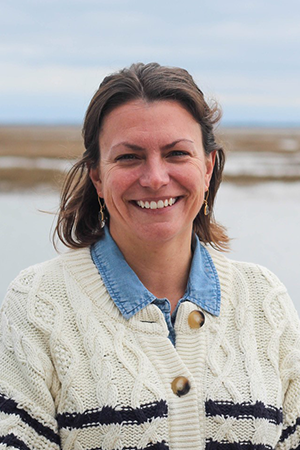
Stacy A. Krueger-Hadfield
Associate Professor; Director, Eastern Shore Laboratory
Email:
[[v|sakh]]
Phone:
(757) 787-8105
Office:
Administration Building, Eastern Shore Laboratory
Section:
Natural Resources
Links:
{{https://www.quooddy.com,Algal Evolutionary Ecology (AlgEE) Lab}}, {{https://scholar.google.com/citations?hl=en&user=8Wj9wQgAAAAJ&view_op=list_works&gmla=AJsN-F4ycychXO6qmVHmqwgGDP1dPrQeprE6B9EGmX7PZJf9ZklQ04EN2VQEJrnW472Tt9pRpP41cbZniyFmKCdfwwII7VuzTgy-A7ezOJbUPQ9ThzBX4Fz-pAKtFX-JvRXAayZdESTN, Google Scholar}}
Education
- B.S., magna cum Laude, California State University Northridge, 2006
- M.S., with honors, California State University Northridge, 2008
- Ph.D., with highest honors, Université Pierre et Marie Curie Paris VI-Sorbonne Université (Station Biologique de Roscoff), 2011
- Ph.D., with highest honors, Pontificia Universidad Católica de Chile, 2011
About
I am an evolutionary ecologist, classically trained in phycology. My research program centers on resolving one of the great paradoxes in biology – the evolution of sex – in which we integrate approaches from population genetics, physiology, and population and community ecology in marine, freshwater, and alpine micro- and macroalgae, with the occasional invertebrate thrown in. The central thread of our research has direct implications for understanding biodiversity, transcending taxonomic designations. All organisms pass through different stages in their life cycle because of sex. These stages often differ profoundly in the number of cells and the arrangement of genetic information due to meiosis, recombination, and fertilization. When, where, and how these stages alternate is affected by genetic and phenotypic factors. Understanding these factors can help us understand the maintenance of eukaryotic biodiversity. Moreover, by focusing on the life cycle, we can compare diverse taxa from apicomplexans to oysters to algae. While theory predicts how sex evolves, there remains a dearth of empirical work confirming these predictions in nature. Marine macroalgae – our focal organismal group – are emerging commodities in the blue bioeconomy. Yet, we lack basic macroalgal biological knowledge, often readily available in other organisms of ecological or economic importance. This is compounded by the absence of macroalgal expertise in soft sediment habitats as compared to rocky shores – an acute issue in the Chesapeake where the last macroalgal species list was published more than 40 years ago. These gaps restrict the responsible development and management of algal resources, but also exacerbate our ability to forecast the consequences of climate change in important primary producers in this region.