
Marine policy sub-concentration cultivates civic leaders transforming science into solutions
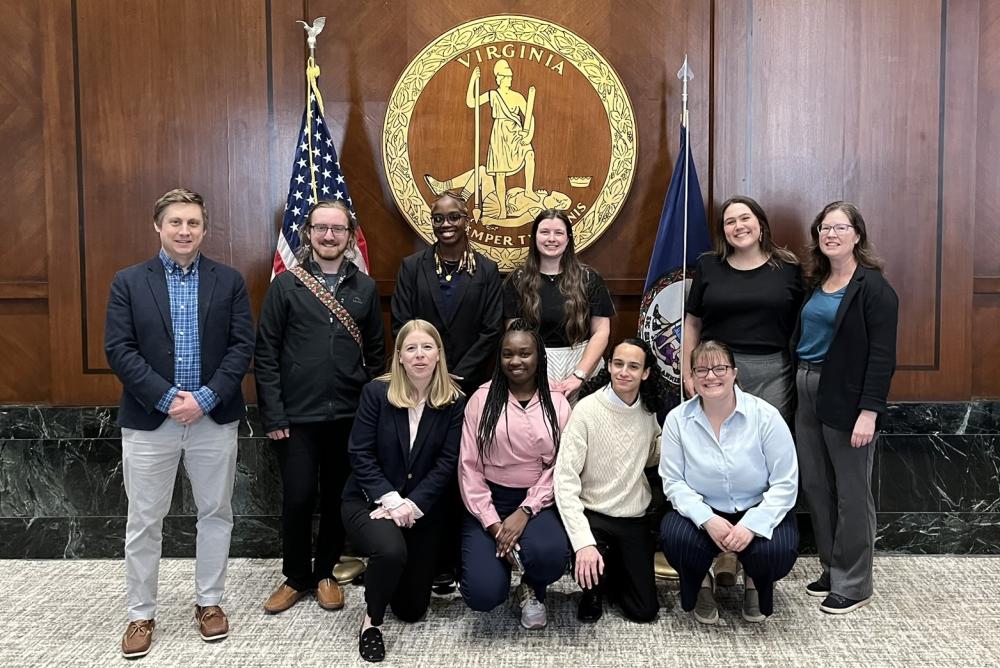 In a classroom overlooking the York River at William & Mary’s Batten School of Coastal & Marine Sciences & VIMS, a cohort of master’s and doctoral students is engaged in a discussion that might surprise some: the Virginia legislative process.
As she maps out how laws are made, Assistant Professor Molly Mitchell pauses to let students absorb the material before pointing to the sequence of events and asking, “So where do you see science fitting into all of this?”
The course is part of the Batten School & VIMS’ Sub-Concentration in Marine Policy. Offered in collaboration with William & Mary’s College of Arts & Sciences Public Policy Program and the William & Mary Law School, it is designed to prepare students to engage with professionals across sectors and fields on matters of coastal and marine policy. The offering provides an alternative to the Combined Degree in Marine Science and Public Policy program, allowing students a holistic educational experience within a typical graduate program time frame.
 Since its founding in 1940, the Batten School & VIMS have advised the commonwealth on marine and coastal issues, drawing on research conducted by faculty, scientific staff and graduate students to serve communities, industries and policymakers in Virginia and beyond. In fiscal year 2025 alone, the Batten School & VIMS consulted on projects valued at more than $1 billion.
Embedded in the Batten School & VIMS’ three-part mission of research, education and advisory service, the art of applied science is especially evident in the classroom, where graduate students engaging in marine policy are transformed into civic leaders.
For Associate Professor Andrew Scheld, who helped formalize the sub-concentration in 2015, the program represents core values shared by faculty, staff and students.
“Our institution is rooted in translating science into policy,” explains Scheld. “There’s always been a strong pipeline from campus to places like Richmond and D.C., where state and federal decisions are being made. Our sub-concentration is a way to provide our students with the structure and the credentialing to further that legacy.”
Over the past 10 years, more than two dozen graduates have earned this specialization alongside their master’s or doctorate degrees, a testament to their passion and drive and an example of how the Batten School & VIMS approach scientific training. While some of these graduates have gone on to lead in the field of coastal & marine sciences, others have taken on roles that more directly apply their marine policy specializations, working as environmental lawyers, climate policy experts, and natural resource managers across the nation.
Siddhartha Mitra, associate dean for academic affairs, explained, “The marine policy sub-concentration captures the essence of our approach to education. We combine innovative research with a focus on how science can inform solutions to pressing global challenges. Coupled with the training they receive here, our talented students become conversant across various sectors and are able to build coalitions and shape policy as future leaders upon graduation.”
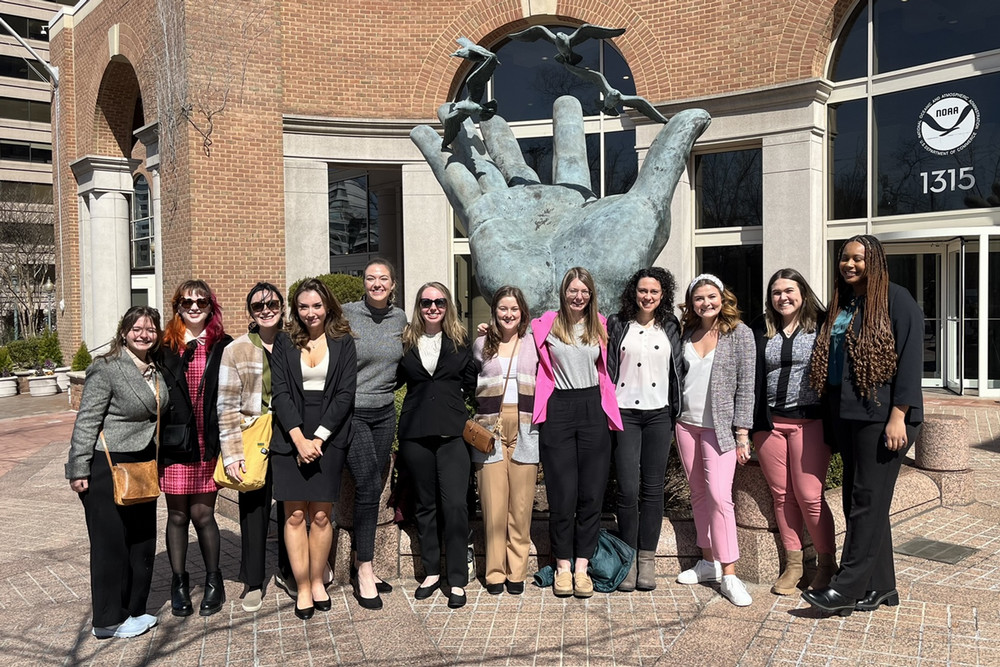
Through required coursework, students develop an understanding of policy structures, working in classroom settings to map out traditional legislative processes and gaining field experience through visits to nonprofits as well as state and federal agencies. Mitchell finds that students gain a more complete appreciation for policy as an art form.
“In class we talk about where science fits into policy decisions,” reflected Mitchell. “It’s often diffusive, intangible – and so it’s important for our students in this program to engage with people across sectors and levels of government, to see and hear them modeling that process for them.”
Providing unique personal growth and professional development opportunities
For graduate students like Mara Walters, the sub-concentration was influential in choosing to attend the Batten School & VIMS. 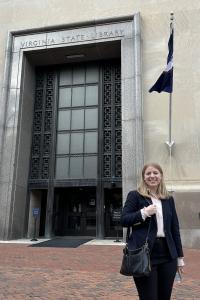
“I knew I wanted to study microplastics, but it was important to me that I complement my scientific training with the personal and professional development that would allow me to translate my research into meaningful actions and answers for people’s concerns,” said Walters, who added, “I think it’s rare that an institution allows for students pursuing their master’s or Ph.D. to focus time and energy away from their primary research subject – but faculty here get it.”
Participation in the marine policy sub-concentration has proven to inspire students to further expand upon their interdisciplinary educational and professional experiences. Since the academic program was formalized, 1 in 3 participants have gone on to become Knauss Fellows, a NOAA Sea Grant program where participants earn one-year paid fellowships working on resource management and national policy within the federal legislative or executive branch.
James DelBene is one such graduate.
“It’s rare to be in a formal science program and also taking a law class alongside law school students or taking a policy course alongside public policy graduates. I don’t take it for granted that in a given week I was shifting between scientific research and meeting with policymakers at the state capital, making connections to how the research and the policy work informed one another along the way,” shared DelBene, who is currently completing a doctorate focused on community values in marine and coastal policy implementation.
“The sub-concentration facilitates opportunities for students to network, to see where the rubber meets the road, so to speak. It’s allowed me to approach my work in such a way that I ensure buy-in from the people that I ultimately am trying to serve through my research, and that has been invaluable.”
Collaboration across William & Mary transforms scientists into civic leaders
As the Alma Mater of the Nation, William & Mary has a long tradition of preparing leaders to address the most pressing issues facing communities today. Through opportunities like the marine policy sub-concentration, the Batten School & VIMS ensures such leaders are prepared to navigate the constantly changing environmental and political landscapes ahead of them.
“We are always exploring how this program can evolve,” explained Scheld. “As legal interpretations change, so do our lesson plans. Engagement from nonprofit, state and federal partners is dynamic and influenced by variables students need to become comfortable recognizing and navigating — that experience is an important element of the learning process and of training to become a professional in this field.”
While partnerships in both the commonwealth and the nation’s capital personalize each cohort’s experience, leadership at the Batten School & VIMS continues to develop cutting-edge academic programming and strengthen cross-institutional coalitions in support of current and future students.
Back on William & Mary’s main campus, Thomas Ruppert, assistant provost for coastal resilience & director of the Virginia Coastal Resilience Collaborative, finds that working with Batten & VIMS faculty and students is representative of a larger effort to foster more resilient communities and coastlines.
“In the not too distant past, people were viewed, or expected to be, substantive experts in a particular field,” reflected Ruppert. “As specializations and scope of knowledge continue to grow, it’s less feasible for lawyers alone to draft effective policies to achieve complex resiliency goals for communities. This generation of professionals coming out of the Batten School & VIMS, who have the technical expertise as well as the added fluency in policy and law, are the policy experts and leaders our nation will rely on as we address the challenges and meet the opportunities ahead of us.”