

A longer, hotter reality surrounds marine heatwaves, new study finds
First-of-its-kind study shows ecosystems experience far more cumulative heat than standard measurements capture.
Anyone who has boiled a pot of water understands that it takes both time and energy to raise the temperature, so it may come as a surprise to learn that scientists have long treated marine heatwaves (MHWs) as isolated events. New research led by William & Mary's VIMS & Batten School is challenging that narrative by providing a framework to characterize an ecosystem’s cumulative heat exposure from MHWs and the extended periods of warm water that precede and follow them.
The study, published in Nature’s Communications Earth & Environment, classifies periods of warming leading up to and following MHWs and provides a framework for assessing cumulative heat exposure. The research aims to provide a more effective measure of ecological impacts by treating MHWs as part of broader warming events, rather than isolated events, based on long-term observations from across 20 U.S. estuaries.
"We started to notice these warm-water anomalies on either side of marine heatwaves and realized that they’re actually embedded within larger periods of warm water," explained lead author Ricardo Utzig Nardi M.S. ‘25, a research specialist working with coauthor Piero Mazzini, assistant professor at VIMS & the Batten School of Coastal & Marine Sciences. “It sounds obvious, but studies usually focus only on the marine heatwave window and that’s not an accurate representation of real-world conditions.”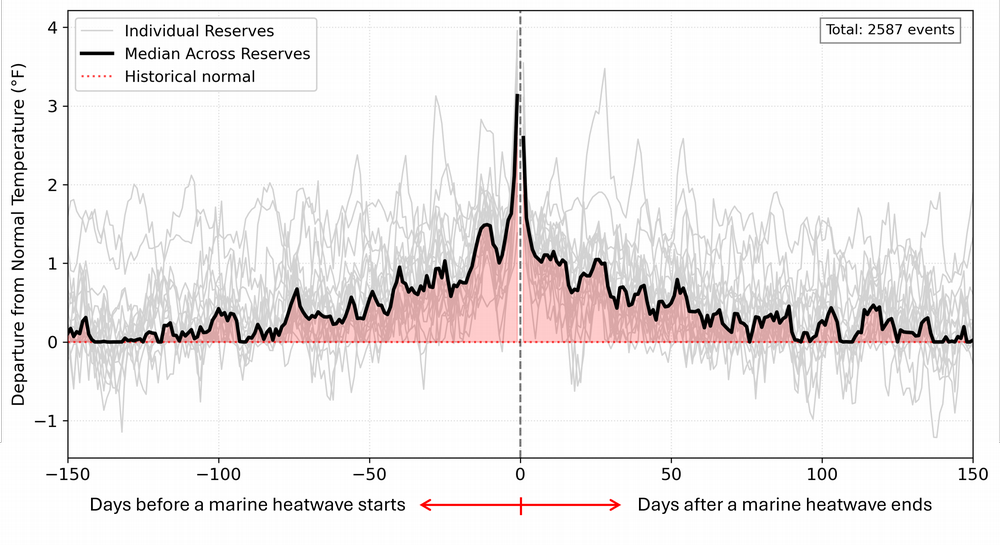
Nardi found that these periods of sustained warming can last for weeks to months at a time, with a distinct marine heatwave embedded between them. The study revealed that in many cases, these pre- and post-heatwave phases contributed as much or more cumulative heat exposure than the MHW phase itself.
“We can no longer look at marine heatwaves in isolation when assessing the impact of warming events on coastal and oceanic ecosystems,” said Mazzini. “We must acknowledge the larger framework in which they exist and this research provides a way to do just that.”
Decades of estuarine data reveal pattern of underestimating thermal stress
The study analyzed more than 2,580 MHWs recorded over two decades at 20 estuaries throughout the United States and found that historic assessments underestimate total heat exposure by more than 150% on average, with significant implications for ecosystem health.
“Consider spending time in the sun,” said Nardi, explaining the importance of cumulative heat exposure. “Your risk of sunburn depends on both sunlight intensity and how long you're exposed to it. A few minutes may cause little harm, but hours of exposure can take a toll. It's similar for marine organisms and warm water. Their biological responses depend not only on how warm the water becomes, but also on how long that warming persists. Prolonged, cumulative heat exposure, especially when combined with other stressors, can create conditions that some species may not be able to survive.”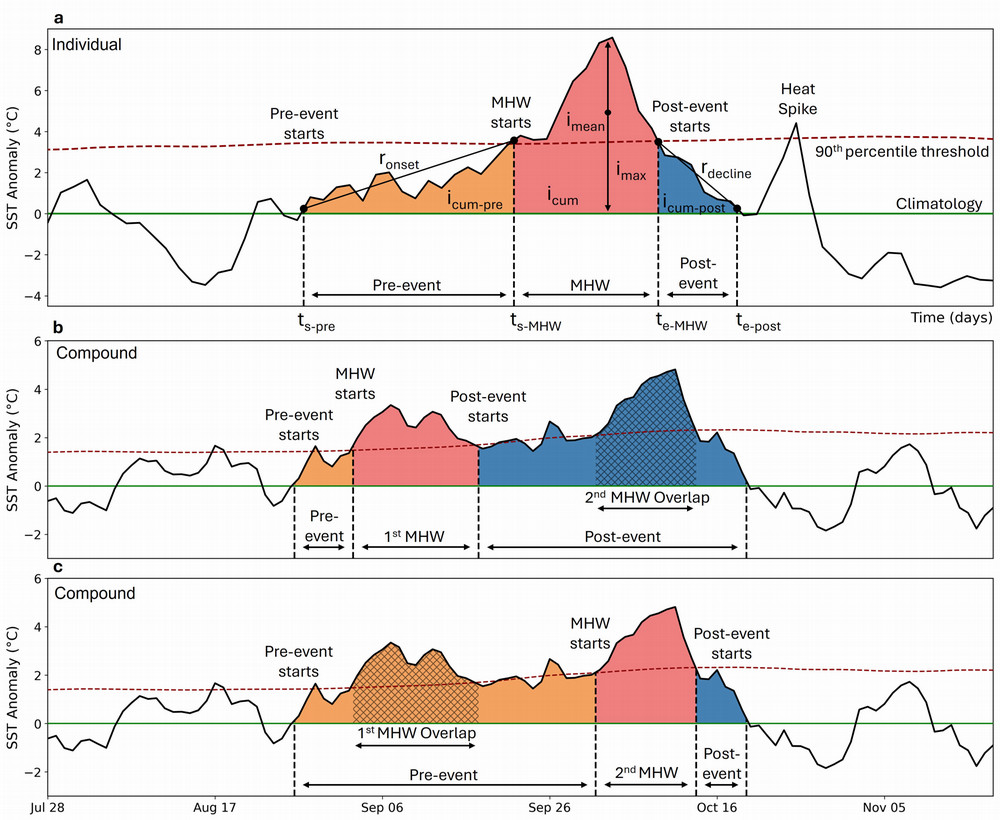
Results concluded that pre- and post-heatwave warm water anomalies are largely independent of the MHW itself, challenging conventional interpretations of heat stress. The findings establish a new framework for evaluating total heat exposure that can be applied across coastal ecosystems.
The study also identified two distinct categories of MHWs. About two-thirds were “individual” events embedded within roughly 60 days of elevated temperatures beyond the MHW itself. The remaining one-third were "compound" events, producing prolonged periods of warming (approximately 90 days) before and after MHWs and generating more than three times the cumulative heat exposure of the MHW itself.
“As you can see, these are remarkably long periods of thermal exposure,” explained Mazzini. “Many laboratory experiments simulate marine heatwaves by increasing temperatures for a few days or weeks in total. Our findings demonstrate that while these experiments hold value, they often fail to capture the prolonged thermal exposure organisms experience in nature. Our research provides a new framework for designing experiments that reflect natural marine heatwave conditions and quantify cumulative heat exposure, allowing scientists to better evaluate the biological impacts of marine heatwaves across ecosystems.”
A surge of VIMS & Batten research is heating up our understanding of marine heatwaves
This study is the latest publication on MHWs from VIMS & Batten School faculty and researchers. Mazzini and Nathan Shunk, a third-year Ph.D. student, recently published an article that defined "vertical marine heatwaves" and introduced a classification scheme for them in the Bay. Last year, Nardi and Mazzini published another Nature article forecasting an increase in MHWs along the U.S. East Coast and identified relationships between MHWs and large-scale climate patterns, including El Niño and the Pacific Decadal Oscillation.
"This study is an example of outstanding science born from a simple question about temperature's relationship to water quality conditions in estuaries," said Mazzini. "It was made possible by NOAA's National Estuarine Research Reserve System and its long-term, high-frequency temperature observations. Comprehensive monitoring programs like these allow us to ask bigger questions and uncover patterns that would otherwise remain hidden."
The new findings also have practical implications for coastal communities and resource managers. Extended periods of warm water can compound the effects of environmental stressors like low-oxygen conditions and harmful algal blooms. This places additional strain on marine ecosystems, from seagrass beds to coral reefs. By incorporating these adjacent warming periods into ecological assessments and laboratory experiments, scientists may develop more realistic predictions of ecosystem vulnerability to better advise conservation and management decisions.
“This research has the potential to shift our understanding of the role warming waters play in ecosystem health by widening our focus beyond the heatwave window, so that we consider the full impact of temperature across time,” explained Nardi. “I’m excited to discover what we may have missed before with this new perspective.”
As MHWs increase in frequency and intensity, understanding their cumulative impact on ecosystems is key to protecting coastal resources and preparing communities for a more resilient future.