

Annual “Roanoke Roundup” pushes students out of their comfort zone and into the brightly colored world of Appalachian freshwater fish
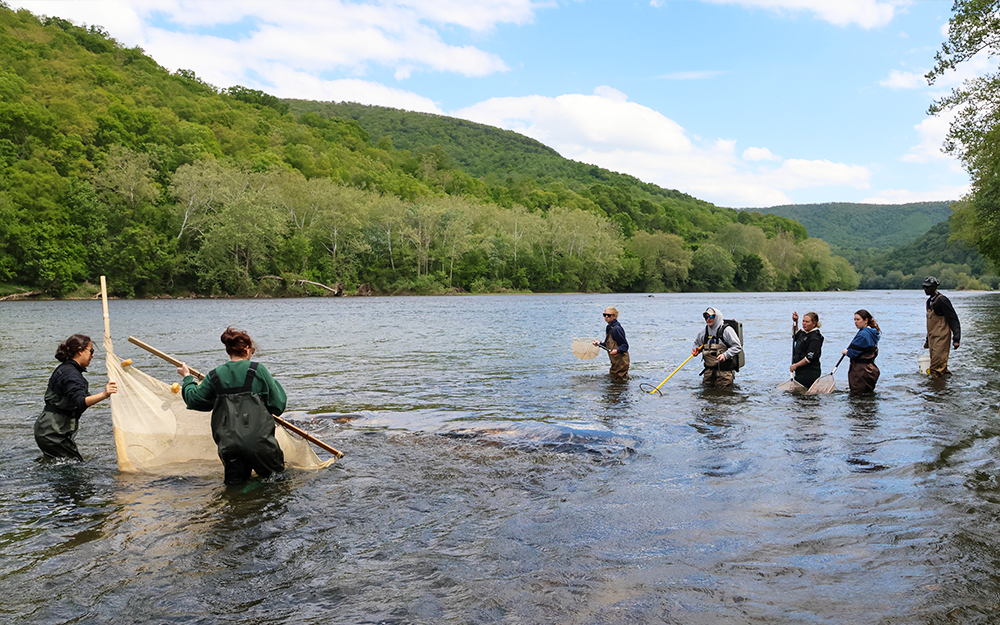 The large passenger van took the winding turns carefully as its occupants, worn out from a long day of specimen collection, quietly took in the majestic views just outside their windows. Above them, rolling Appalachian mountain peaks, replete with fresh spring foliage. Below, the rapidly flowing currents of the New River, where moments ago they had stood in frumpy-but-functional waders that kept the brisk waters at bay.
The van occupants were graduate students at William & Mary’s Batten School & VIMS who dedicated a long weekend to researching freshwater fishes. Behind them followed a truck holding the fruits of their labor: containers preserving an array of exquisitely patterned fishes ready to be identified and catalogued.
{{youtube:medium:right|4p1l3lj1qTA}}
Though the rivers and streams of Appalachia are not tropical, those who join the annual “Roanoke Roundup” research trip know that these ecosystems, and the organisms that live within them, are no less exotic.
“You're in the beautiful mountains, the water is crystal clear and the fishes are so colorful,” said Emily Echevarria, a second-year Ph.D. student at the Batten School of Coastal & Marine Sciences & VIMS. “As soon as they float up to the surface, you're like, ‘Oh gosh, that fish is bright blue and bright orange!’ It's unexpected, and very cool.”
A friendly debate becomes an unrivaled research tradition
For 56 years, the Roanoke Roundup has immersed scientists and students in the tributaries of Southwest Virginia. Scenic collection sites, colorful freshwater fishes and long days in the field and lab combine deep in the Appalachian Mountains to create one of the Batten School & VIMS’ most unique educational opportunities. During the trip, students collect, identify and preserve specimens of fishes for the Nunnally Ichthyology Collection at the Batten School & VIMS, while building both scientific skills and cohort camaraderie.
The Roanoke Roundup began as a friendly debate between colleagues. The late Roanoke College Professor Bob Jenkins was trying to convince the late Batten School & VIMS Professor Jack Musick that the freshwater fish Jenkins investigated were as diverse and interesting as the saltwater fish Musick researched. The discussion turned into an invitation for Musick and his students to collect and study mountain fish for themselves. Since then, the research trip has continued uninterrupted, apart from a single year pause in 2020 due to the COVID-19 pandemic.
 “The Roanoke Roundup is what I think is the finest VIMS tradition,” said Eric Hilton, the professor who now leads the trip alongside Patrick McGrath, a marine scientist.
“Students who attend are generally associated with my ichthyology class,” said Hilton, “but the main goal is more than increasing their appreciation of fish diversity — it’s to get them out of their comfort zone. Many of them have never even thought about freshwater fishes before. Seeing new habitats, fish communities and ecological settings, while learning how to collect, sample and identify different species, gets students to think in a different way. It's good for their soul, really.”
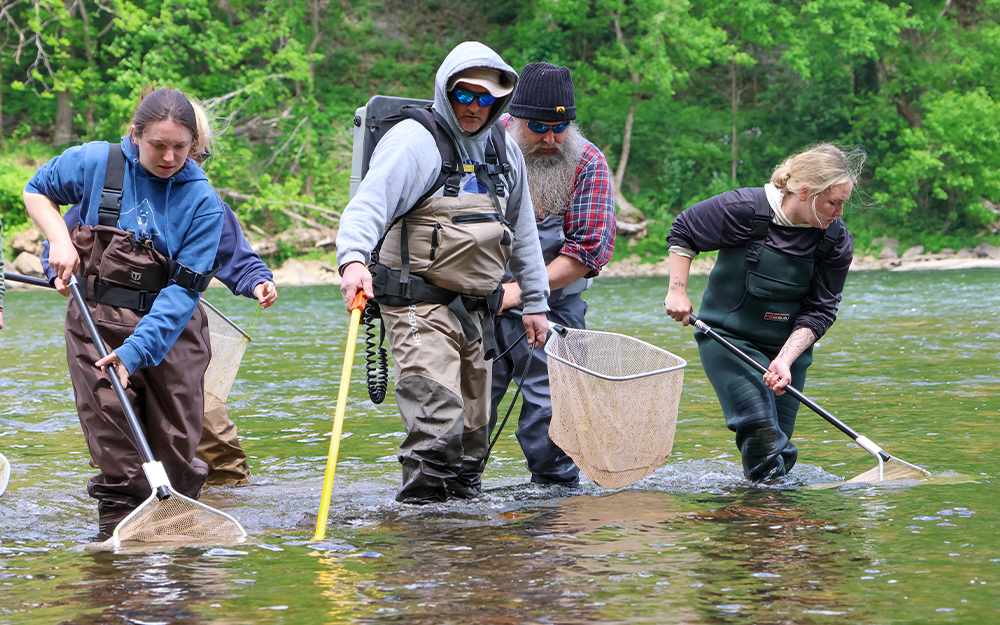
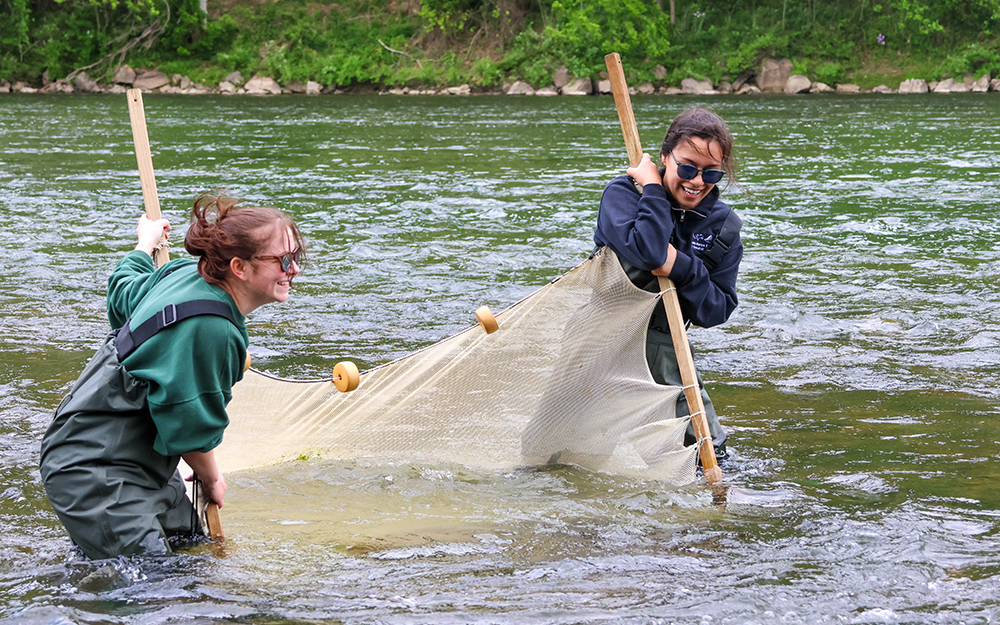
Held in early May, this year’s trip took students to collection sites in the Middle, James, Clinch, North Fork, Holston, Roanoke, and New River drainages, where backpack electrofishing equipment catalyzed the collection process. Handled by a trained operator, a controlled current flowed from the battery pack through a pole-like electrode and into the water, temporarily immobilizing fish and allowing students to scoop them up with dipnets. In areas with a strong current, the researchers coordinated a two-person seine that could capture stunned fish that float away from the dipnets too quickly.
Slowly but surely, participants surveyed the sample sites, moving 10 to 20 yards at a time before resetting the seine. That steady, deliberate strategy paid off, bringing scientists face-to-face with a wide variety of species, including those with conservation significance.
 Making discoveries and expanding datasets
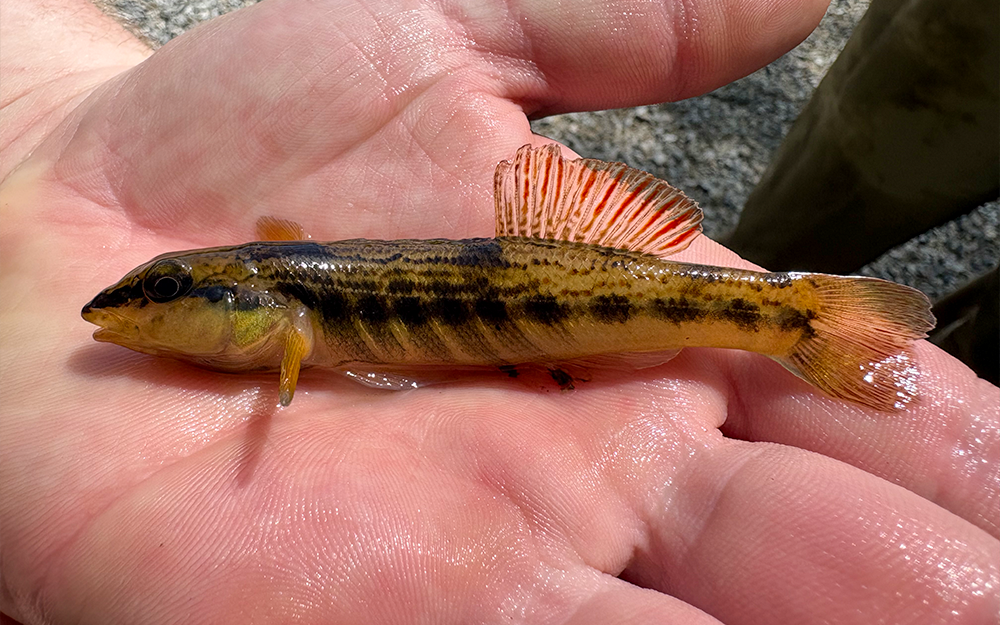
“My favorite fish from this weekend has to be the ashy darter,” said Hilton. “It’s a state-endangered species that was once thought to have gone extinct in Virginia. It is only spotted rarely, and it had never been seen at the site where we encountered it.”
The darter was swiftly released back into the water, but not before Hilton took a photograph to send to a colleague at the Virginia Department of Wildlife Resources. “They were very excited to know there was a new record of the ashy darter in a new location,” he said.
Uncollected fish quickly regained movement and swam away, and most of the captured fish were also returned to their habitat. Those that were retained serve important research purposes. Some are utilized for tissue samples, known as voucher specimens, which are essential for DNA analysis. Others were preserved for later identification ahead of being added to the Nunnally Ichthyology Collection at the Batten School & VIMS.
For over half a century, the Roanoke Roundup has expanded the collection’s freshwater holdings by the thousands, providing scientists with a vital, continuous record. According to Sarah Huber, collection manager, the research trip has added over 26,700 individual specimens to the collection, representing 143 distinct species.
 The samples, and their resulting data, are made available to support a range of current and future research into freshwater population trends, biodiversity, ecology and more. To date, Huber has loaned out over 200 lots, or groupings of individual specimens, from the Roanoke Roundup to scientists conducting various research.
“Long after I’m gone,” Hilton ruminated, “somebody will look at our samples and say, ‘These people collected this, and that fish doesn’t exist there anymore,’ or, ‘That was the first record of that fish this in this drainage.’ That’s a pretty cool piece of time-capsuling that we’re doing.”
An experience that’s about more than catching fish
Following each arduous day of sample collection, students returned to their home base for the weekend, Mountain Lake Biological Station, a research outpost in Giles County operated by the University of Virginia. They devoured dinner — the last night always features Hilton’s home-cooked chili — before trudging through the cold to a makeshift lab in an uninsulated cabin.
There, with only a wood-burning fireplace for warmth, they spent several more hours working on species identification. Microscopes, collection jars, textbooks and energy drinks remained scattered across lab tables until the early hours of the next morning.
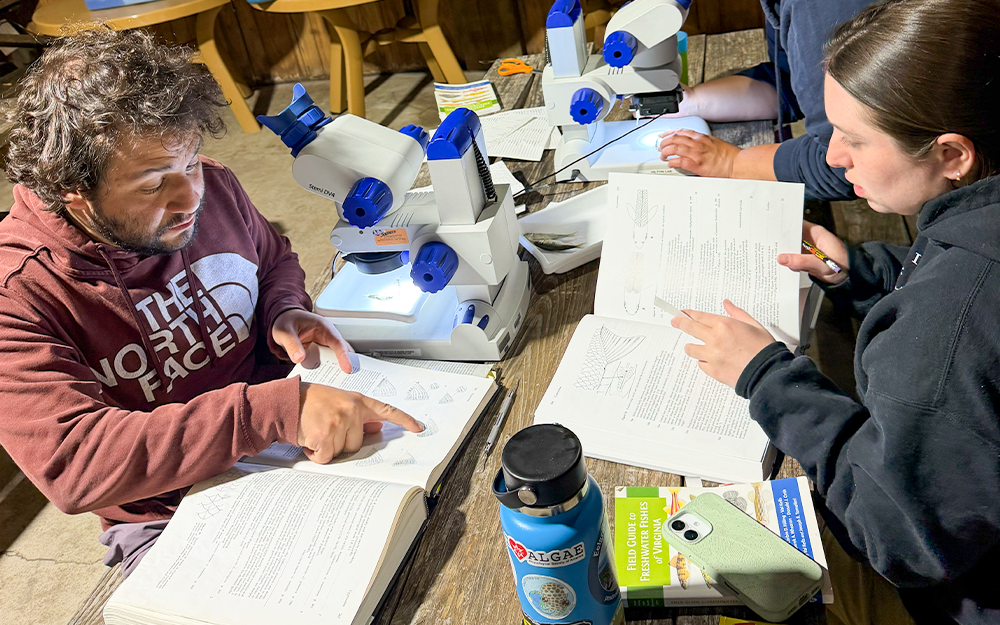 Clearly, the Roanoke Roundup is not a day in the park. From relentlessly pursuing samples in strong river currents to hunching over microscopes for hours on end, the days that began at dawn and ended well past midnight were long and hard. Yet it’s the challenge itself that appealed to many of the students who attended.
“If you're coming to the Roanoke Roundup, you should be prepared to experience things outside your comfort zone,” said fifth-year Ph.D. student Miguel Montalvo, echoing his advisor, Hilton. “You’ll be going into a river, getting wet, working with these magical, colorful specimens. It’s tiring for a few days, but it’s also fun and a great experience.”
Ned Rose, who will begin his graduate studies at the Batten School & VIMS this fall, concurred. “There's nothing like the Roanoke Roundup and its flurry of biodiversity,” he said. “There's just so much life, so many new experiences. You’ll never forget it.”
Several participants said they signed up for the research trip because they thought it was important to “get outside the [Chesapeake] Bay,” as Echevarria described it, and experience different kinds of ecosystems and species. On campus, students’ research interests range from sandbar sharks to red algae, but on the Roanoke Roundup these young scientists are challenged to think outside of their usual saltwater boxes and develop new skills that can inform their work even once the trip is over.
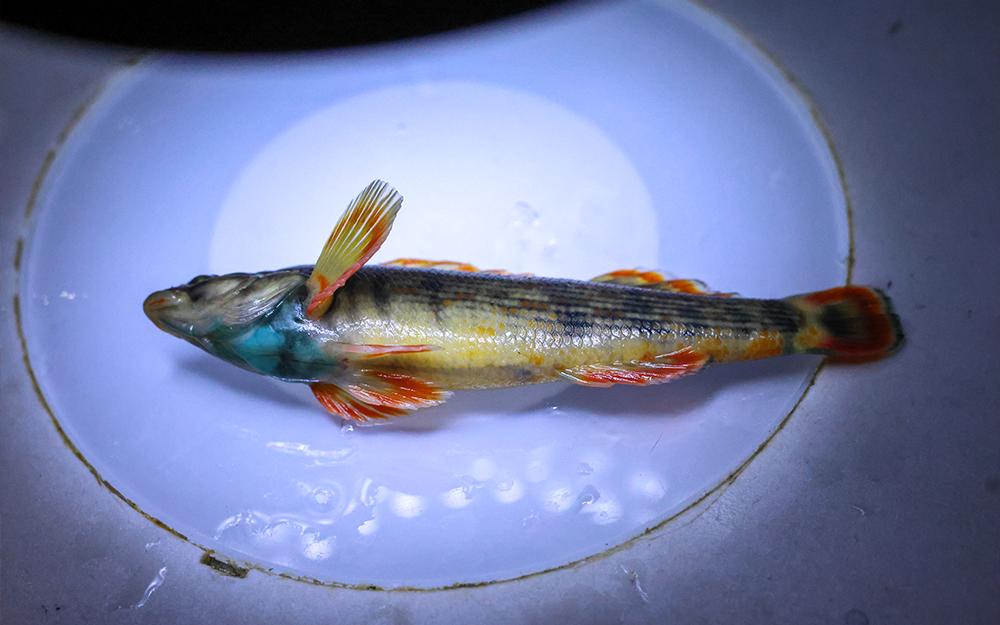
“As an ecologist, it's very important to understand ecosystems as a whole, so that’s why I took the ichthyology class,” said first-year M.S. student Sarah Allen. “It's been harder than I expected, but I think the Roanoke Roundup has helped a lot.”
Montalvo remarked how unique of an opportunity it was to catalog fish that will be added to a specimen library, while Echevarria noted that the trip lets them practice and develop their ability to identify samples.
“The best part has been seeing how much we improve at identifying each night,” said Echevarria. “The first night we were struggling, but by the last night we were like, ‘I remember this fish!’”
In all, seven students attended the 2026 Roanoke Roundup and each one endorsed both returning and encouraging others to join. It was a smaller group than usual, but they were no less enthusiastic about the work, the camaraderie and the lessons learned.
The students credited that success to the capable leadership and dedicated mentorship of Hilton and McGrath. However, the Roanoke Roundup turned out to be equally inspiring for the instructors.
“I get rejuvenated every time I come out here,” said Hilton. “Only two students had been here before, and to see their faces when they pull up their first madtom or their first big tangerine darter — that’s pretty cool, and gives me a strong sense of impact.”