

Inaugural VA SEA Conference advances science education through research-based lesson planning
Virginia Scientists & Educators Alliance expands on lesson planning process with new conference emphasizing feedback, collaboration
Here’s one: how can you tell when sharks are stressed out?
This isn’t just the setup to a joke, it’s also a prompt from one of 10 lesson plans explored during the first-ever Virginia Scientists & Educators Alliance (VA SEA) Lesson Plan Conference at William & Mary’s Batten School of Coastal & Marine Sciences & VIMS.
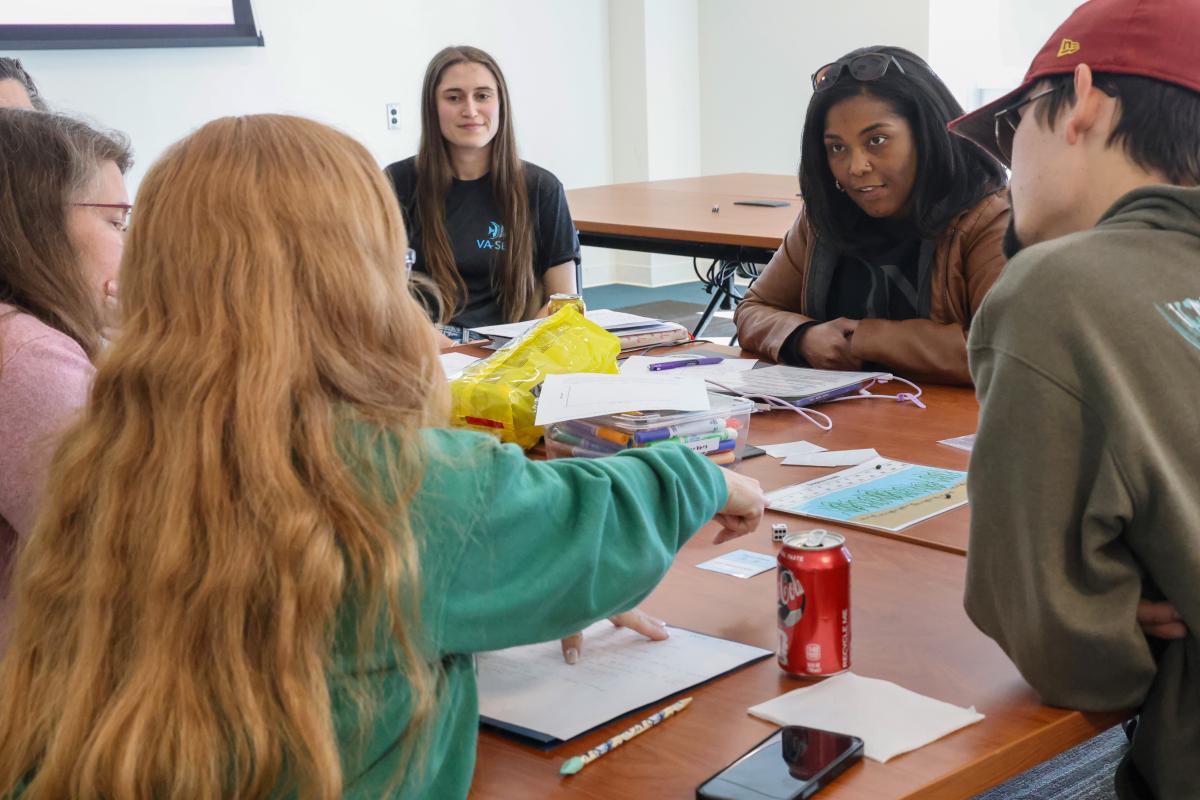
On January 15, middle and high school educators from across Virginia gathered at the Batten School & VIMS Gloucester Point campus to review newly drafted lesson plans designed by graduate students from Virginia Sea Grant–affiliated universities.
Hosted by the Batten School & VIMS Office of Outreach & Engagement, the conference allowed graduate students to gain structured feedback on lesson plans and insights into classroom management best practices. Educators left with a complete lesson plan and supporting materials to test-pilot in their classrooms, gathering feedback for the graduate students to incorporate ahead of publication.
The lesson plan process began last fall with a workshop series that trained graduate students in pedagogy and science communication best practices and culminates this April with the Lesson Plan Expo, where the lessons will be made publicly available.
Since it was established in 2015 at the Batten School & VIMS with support from Virginia Sea Grant and the Chesapeake Bay National Estuarine Research Reserve in Virginia (CBNERR-VA), VA SEA has hosted 76 graduate students and developed 87 K-12 lesson plans, with over 26,000 downloads across 172 countries.
“This first, in-person teacher conference model created an important connection between graduate students and teachers,” explained Lisa Lawrence, associate director of strategic initiatives & broader impacts at the Batten School & VIMS. “Teachers got to experience the lessons alongside the students who designed them, creating a meaningful opportunity for feedback and clarity ahead of classroom testing and lesson plan publication.”
Through VA SEA, scientists and educators take research from the field and bring it into the classroom
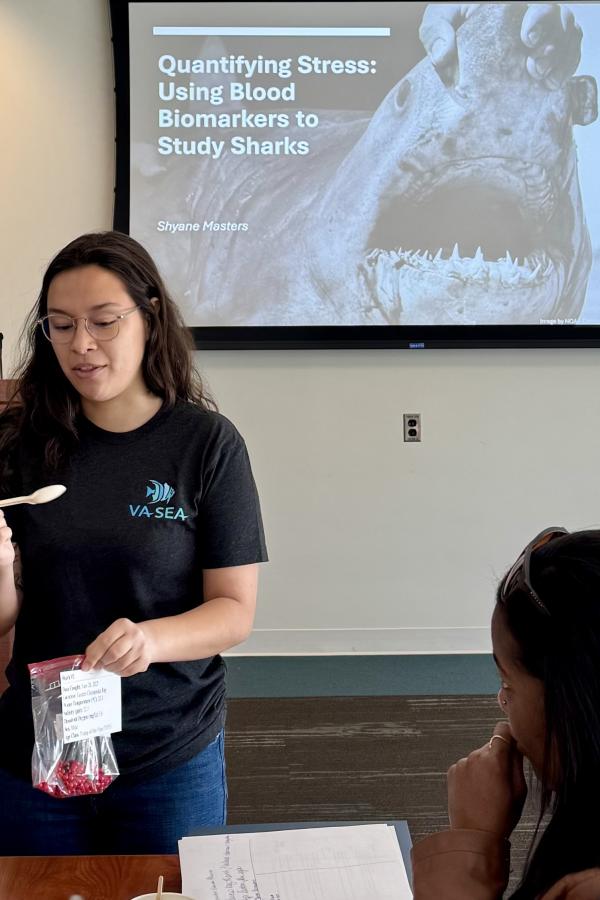
In Quantifying Stress: Using Biomarkers to Study Sharks, a lesson plan designed by Batten School &VIMS graduate student Shyane Masters, high school students are asked to take on the role of a scientist studying the ways in which varying environmental factors are most closely related to stress in sharks. As teachers moved through the structured lesson, sorting colored beads to mimic blood analysis in a lab, Masters provided background on the applicable research.
“Broadly, what I study is how stressful events, such as getting hooked, caught in a net or being exposed to environmental conditions, like low oxygen availability in the water, affects the survival of the sharks,” Masters explained. “I do this by taking blood samples from sharks and studying the biomarkers within their blood. With this lesson plan, the students can mimic that work experience, turning data into graphs that identify patterns and help tell a story about shark health.”
Down the hall, there was a literal wave of commotion.
Charlotte Henderson, a graduate student at UNC-Wilmington, demonstrated her lesson by generating small waves in a plastic bin. In Data-Driven-Decision Making: Seagrass Restoration as an Example of Environmental Problem Solving, transects with varying concentrations of seagrass — represented by strands of green ribbon — swayed in a shallow pool to demonstrate how benthic habitats stabilize shorelines.
On the lesson planning process, Henderson shared, “The workshop was amazing. I’m definitely more on the science side of things, so I wasn't super familiar with how to develop a lesson plan. The entire team was informative and supportive, showing me ways to communicate to a certain grade level in a format that would work for teachers and be accessible to students.”
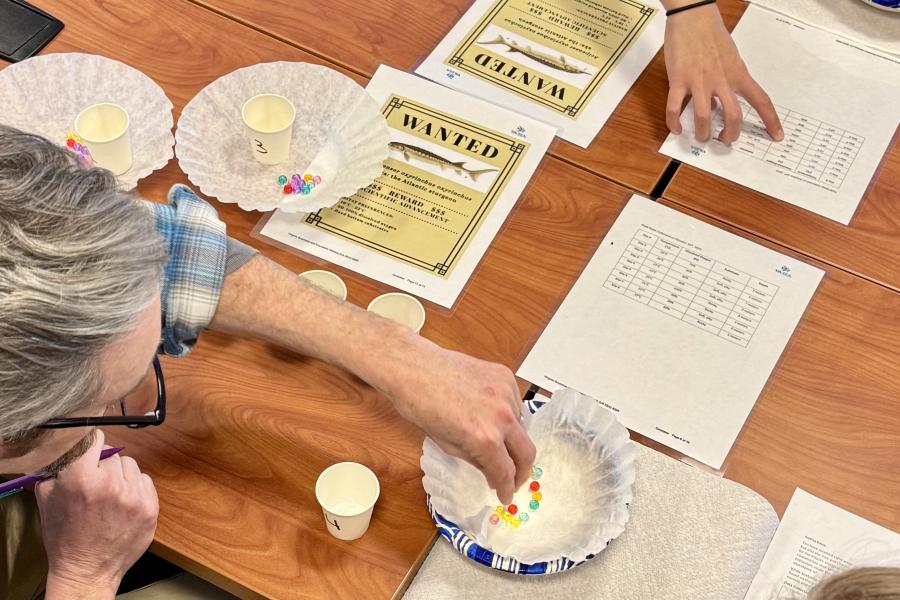
Nicole Snyder, a dual enrollment teacher at Hampton’s Phoebus High School, took home Henderson’s seagrass lesson plan. For Snyder, the opportunity to collaborate with the student who designed the lesson they will pilot-test held immense value.
“Being able to meet and work through the lesson together in person was really cool,” said Snyder. “Charlotte and I were able to bounce ideas off one another, to explore how this can best work for my students, and how the supporting documents and timeframe will fit into my curriculum. It’s perfect for this year’s Coastal Oceans lab.”
“Teachers consistently tell us they want classroom-ready lessons grounded in authentic research, and our graduate students help meet that need,” explained Sarah Nuss, director of outreach & engagement at the Batten School & VIMS. Along with Lawrence, Nuss leads the VA SEA program and provides graduate students with translating their research into adaptive educational products. “While the work starts locally, VA SEA lesson plans have reached educators around the world.”
For teachers, Lesson Plan Conference and Expo provide endless opportunities & resources
For Judy Green, a Peasley Middle School teacher in Gloucester, VA, a conference like VA SEA is an exciting opportunity to give back while staying connected to current scientific research. “Events like these keep me charged,” Green shared. “I get to discover and learn myself — to become a student for the day. The excitement I gain hearing these graduate students explain their research — it shapes the way I teach. I take that energy back with me and share it alongside the lessons.”
The process is beneficial for both the graduate students and teachers. As Amber LaMonte, an educator from York County explained, “I really enjoy giving the graduate students an understanding and lens into where our students are at, and what that means for how science is delivered and explained. The result of that feedback loop has been terrific — VA SEA’s lesson plans are excellent, the Lesson Plan Expo is always impressive — and as a public school teacher it’s meaningful to receive free and current resources like these.”
“There’s another secret message within all of this that is especially important for students to hear and that I reflect on when pilot-testing a lesson,” shared Jennifer Dunn, a Loudon County Public Schools teacher. “That it’s okay — great, even — to try something and then share it with the world, even if it’s not conceptually perfect. These are graduate students and scientists creating lesson plans and sharing them with educators for feedback and collaboration — that’s something students should see being celebrated.”
…Okay fine, we’ll finish the joke:
How can you tell when sharks are stressed out?
...They’ve got clenched jaws. 🦈