

Bluntnose stingray
Dasyatis say
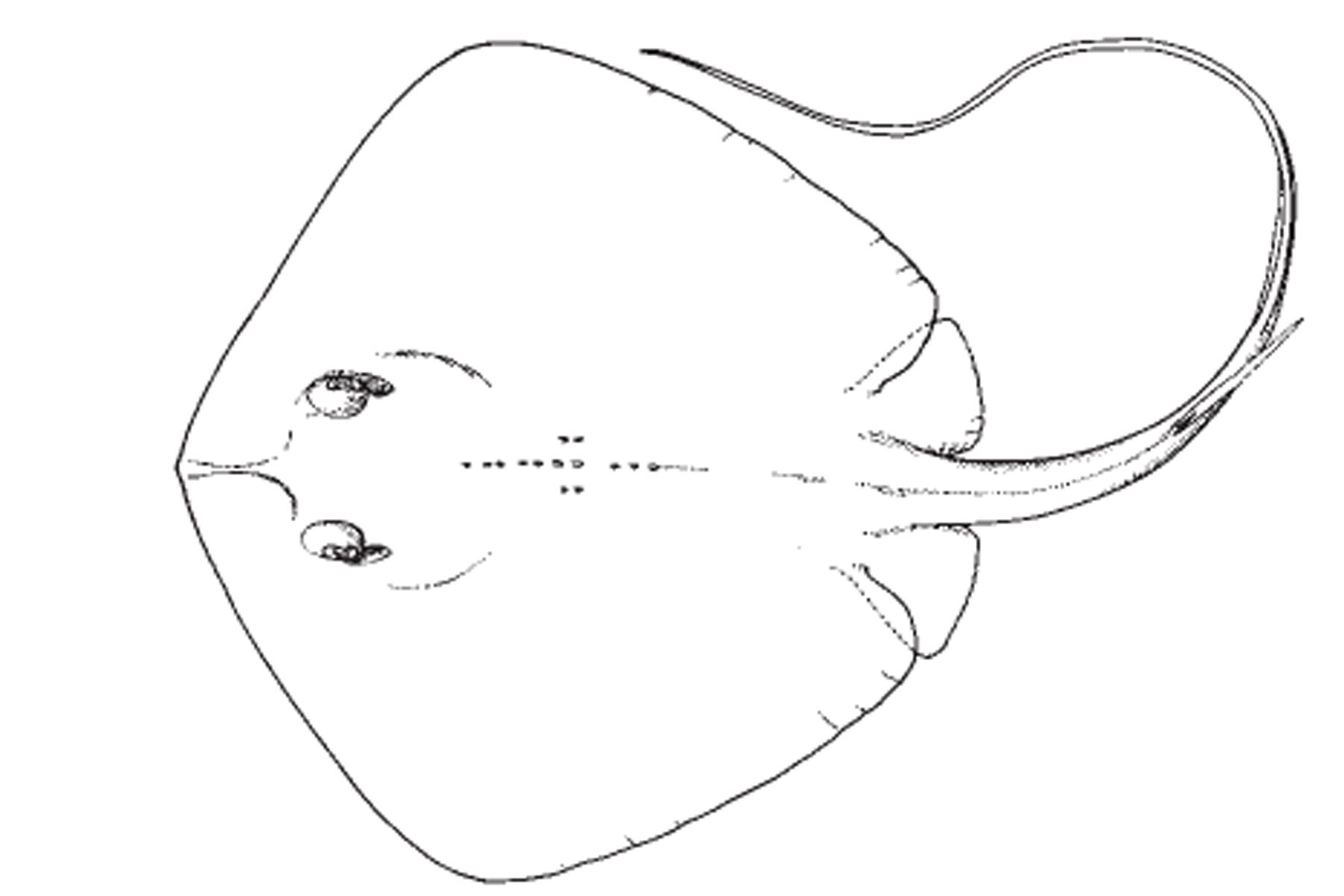
Information and species illustrations courtesy of the Food and Agriculture Organization of the United Nations (FAO).
SizeMaximum size 100 cm disc width;neonates 15 to 16 cm at birth |
Diagnostic charactersBatoids of moderate to very large size, disc width from 30 cm to more than 2 m. Body strongly depressed, with head, trunk, and broadly expanded pectoral fins forming rhomboid disc. Anterior margin of disc subangular, with tip of snout forming apex of angle. Disc not more than 1.3 times as broad as long. Tail distinctly demarcated from disc. Pectoral fins continuous along sides of head, not forming subrostral lobes or cephalic fins. Pelvic fins not greatly expanded laterally, only about as wide as long, and with broadly and evenly rounded outer corners; Preorbital length shorter than distance between spiracles; pelvic fins usually not projecting beyond posterior margin of disc, or, if projecting, never by as much as 1/3 their length. Snout obtuse, rounded, or more or less pointed. Eyes and spiracles on top of head. Floor of mouth with fleshy papillae. Small teeth in many series forming bands along jaws. Nasal curtains well developed and continuous across narrow isthmus in front of mouth and deeply fringed. No dorsal fins or caudal fin. Tail very slender, tapering, much longer than disc, and with 1 or more saw-edged, long, poisonous spines on medial half of length. Skin on dorsal side naked or armed with tubercles or prickles. Colour: dorsal surface usually grey to dark brown, sometimes with darker or paler markings; ventral surface generally whitish.
|
Habitat, biology, and fisheriesFood consists of polychaetes, bivalves, gastropods, and ray-finned fishes. Litters range from 2 to 4 young. Dorsal surface greyish brown, olivaceous brown to reddish, occasionally with bluish spots; ventral surface whitish. Both upper and lower fin-folds well developed, even in late term embryos. |
DistributionBenthic along the shoreline to 9m; also occurs in estuaries. Recorded from New Jersey to Florida Keys, northern and western Gulf of Mexico, Greater and Lesser Antilles, and eastern Venezuela to northern Argentina. It has not been recorded from the southern Gulf of Mexico or the Caribbean coasts of Mexico and Central America. Records of Dasyatis pastinaca from Uruguay and Argentina probably refer to this species or Dasyatis americana. |
CitationsCarpenter, K.E. (ed) Carpenter, K.E. (ed) Carpenter, K.E. (ed) |