

Cobia
Rachycentron canadum
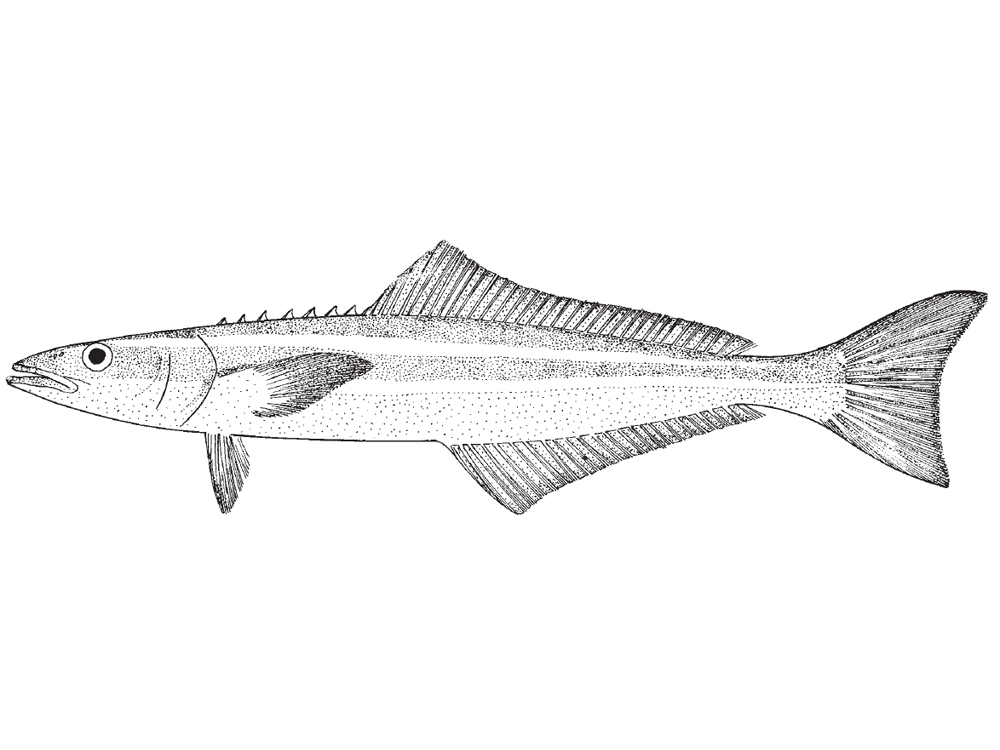
Information and species illustrations courtesy of the Food and Agriculture Organization of the United Nations (FAO).
SizeMaximum to 200 cm; commonly to 110 cm. The IGFA all-tackle game fish record is 61.5 kg for a fish caught in Western Australia in 1985. |
Diagnostic charactersColour dark-brown dorsally, paler brown laterally and white ventrally; black lateral band as wide as eye extends from snout to base of caudal fin, bordered above and below by paler bands; below this is a narrower dark band. Black lateral band very pronounced in juvenile, but tends to be obscured in adult. Body elongate, sub cylindrical; head broad and depressed. Mouth large, terminal, with projecting lower jaw; villiform teeth in jaws and on roof of mouth and tongue. First dorsal fin with 7-9 (usually 8) short but strong isolated spines each depressed into a groove, not connected by a membrane, 28-33 rays. Second dorsal fin long, anterior rays somewhat elevated in adults. Pectoral fins pointed, becoming more falcate with age. Anal fin similar to dorsal, but shorter; 1-3 spines, 23-27 rays. Caudal fin lunate in adults, upper lobe longer than lower (caudal fin rounded in young, the central rays much prolonged). Scales small, embedded in thick skin; lateral line slightly wavy anteriorly. |
Habitat, biology, and fisheriesCoastal and continental, pelagic to depths of 50 m over waters as deep as 1 200 m; also found over shallow coral reefs and off rocky shores, occasionally in estuaries. Feeds extensively on crabs, other benthic invertebrates, and fishes. Grows rapidly and reaches at least 8 years of age. Throughout most of its range, cobia are an incidental catch in other fisheries. Caught with handlines, trolling, in pound nets, driftnets, and seines. FAO statistics report landings ranging from 392 to 757 t from 1995 to 1999. Landings totaled 0.46M t globally from 1950 to 2024. Not rare in some local markets. Large size and strong fighting qualities make cobia a favorite of coastal recreational anglers. Marketed mostly fresh, but holds up well as a frozen product, and also makes a fine smoked product. |
DistributionNearly worldwide in subtropical and tropical seas, but absent from the eastern Pacific Ocean and the Pacific Plate. Found throughout the area from Massachusetts and Bermuda southward to Argentina. |
CitationsCarpenter, K.E. (ed) Carpenter, K.E. (ed) Carpenter, K.E. (ed) |