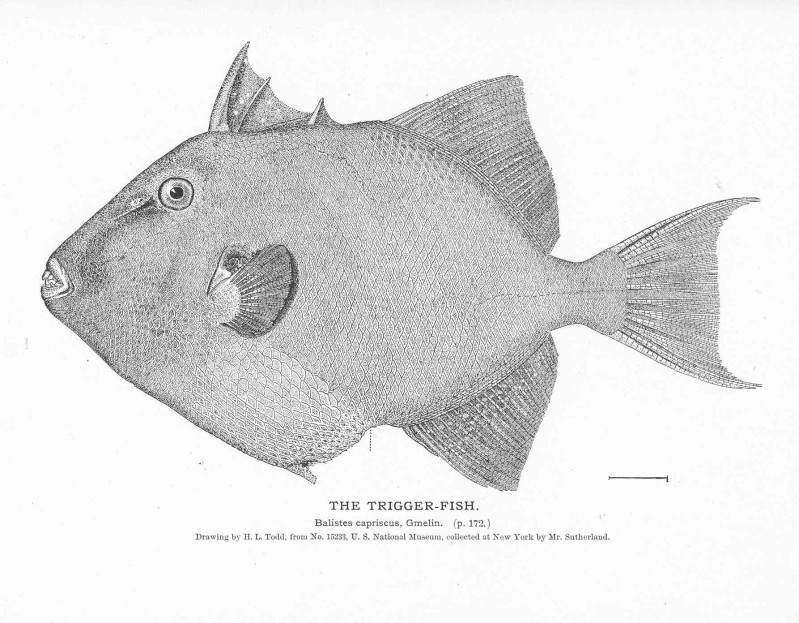
Information and species illustrations courtesy of the Food and Agriculture Organization of the United Nations (FAO).
Species Information
Size
Maximum to about 30 cm; commonly to 20 cm.
Diagnostic characters
Mouth terminal; teeth notched. A small groove in the skin from in front of eye to below low nasal apparatus. Dorsal fin with 3 spines and 27 to 29 soft rays. Anal fin with 23 to 26 soft rays. Caudal- fin rays slightly prolonged above and below. Scales enlarged above pectoral-fin base and just behind gill slit to form a flexible tympanum; scales of body without prominent keels not forming longitudinal ridges. Colour: generally greyish with green overtones and about 3 darker blotches or irregular bars across the back; chin lighter; small bluish to purplish spots on upper body, with lighter spots on lower body, sometimes larger and forming short irregular lines; soft dorsal and anal fins with spots, tending to form rows.
Habitat, biology, and fisheries
Found in shallow water down to about 50 m depth. Nothing definite is known about the areas occupied by this species, but like B. vetula, it seems to occur in coral reef environments including shallow sandy or grassy areas as well as rocky bottoms. Feeds on bottom-living invertebrates. Caught incidentally throughout its range, but apparently not very abundant. Taken in bottom trawls, in traps, and on handlines. The flesh is of excellent quality. Consumed mostly fresh. Separate statistics are not reported for this species.
Distribution
Both sides of the tropical and temperate Atlantic, from Nova Scotia to Argentina, including the Caribbean (rare) and Gulf of Mexico, and from England and Europe to Africa.