

Longhorn sculpin
Myoxocephalus octodecemspinosus
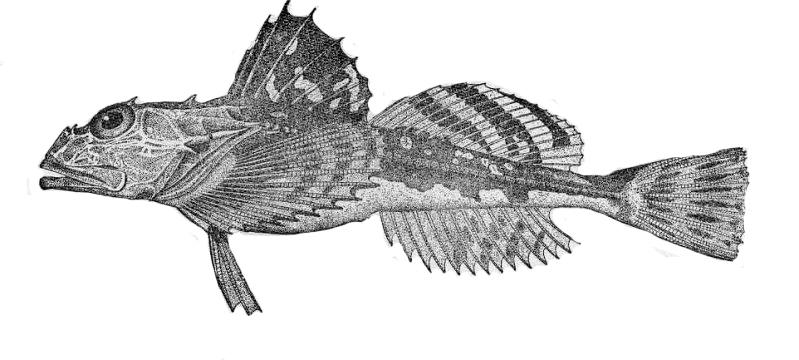
Information and species illustrations courtesy of the Food and Agriculture Organization of the United Nations (FAO), and and
SizeThis is a smaller fish than the shorthorn sculpin. It grows to a maximum length of about 18 inches, but only a few of them are more than 10 to 14 inches long. A 10-inch fish weighs about ½ pound, one 12 inches long about 1 pound. |
Diagnostic charactersThis fish resembles the shorthorn sculpin so closely that the description may be, confined to the points in which it differs. Chief of these is the great length of its uppermost cheek spine, which usually is about four times as long as the spine just below, and which reaches at least as far back as the edge of the gill cover. This serves equally to distinguish the young longhorn from the grubby, which is short-horned. All the head spines, too, of the longhorn are so sharp that one must be cautious in grasping one of these fish, for it turns its spines rigidly outward by spreading its gill covers. Furthermore the long spines of the long horn are naked at the tip. There are two thorns on each shoulder, with a larger one close above the origin of the pectoral fin. The first dorsal fin is higher than the second (in the shorthorn sculpin these two fins are of about equal heights), of rather different shape from that of the shorthorn and proportionately shorter than in the latter though with about the same number of spines (8 or 9). The second dorsal fin and the anal have the same number of rays (15 or 16 dorsal and about 14 anal) as in the shorthorn; but the anal of the longhorn originates Under the second or third ray of the second dorsal fin instead of under its fourth or fifth ray. The pectorals are of the fanlike form usual among sculpins. The lateral line of the longhorn sculpin is marked by a series of smooth cartilaginous plates instead of by prickly scales as it is in the shorthorn, a difference obvious to the touch; its body is more slender (about five and one-half times as long as it is deep); and its head is flatter. The longhorn, like other sculpins, varies in color with its surroundings. The ground tint of the back and sides ranges from dark olive to pale greenish-yellow, greenish-brown, or pale mouse color, but is never red or black as the shorthorn so often is. As a rule it is marked with four irregular, obscure, dark crossbars, but these are often broken up into blotches and they may be indistinct. The coarseness of pattern often corresponds to that of the bottom, as does the degree of contrast between pale and dark. On mud and sand bottom this sculpin is often nearly plain colored, but when it is lying on pebbles with white corallines its back is often nearly white with dark-gray blotches, rendering it almost invisible. The first dorsal fin is pale sooty with pale and dark mottlings or spots; the second dorsal is paler olive with three irregular oblique dark crossbands; the caudal is pale gray; and the pectorals yellowish. Both caudal and pectorals are marked with 4 to 6 rather narrow but distinct dark crossbands. The anal is pale yellowish with dark mottlings; and there often is an obscure yellowish band along the lower part of the sides, marking the transition from the dark upper parts to the pure white belly. |
Habitat, biology, and fisheriesIts depth range is relatively wide, abundant in many shoal harbors and bays, where it comes up on the flats at high tide, to leave them at low; and it runs up into estuaries, salt creeks, and river mouths, though never into fresh water. At the other extreme it is caught in considerable numbers down to 50 fathoms or so, and it has been reported as deep as 105 fathoms. The longhorn evidently is at home in temperatures as high as about 65°-66°, or even a little warmer, in summer in the southern side of Massachusetts Bay. But in localities where the temperature of the upper few feet rises much higher than this they withdraw to somewhat deeper (i. e., cooler) water for the summer, working inshore again in the autumn. At the other extreme, it is subjected for the coldest part of the year to water as cold as 32°-33°, both in our Gulf, along the Nova Scotian shelf, and in the Gulf of St. Lawrence, while it has been reported from water of 31°-32° F. (-0.3° C.) in the bottom of Trinity Bay, Newfoundland. And it seems that even exposure to freezing temperature may not be fatal. Ripe eggs are about 0.85 mm. in diameter before being laid, but they swell when they come in contact with the water; they are described as varying in color, from coppery green to reddish brown, orange, or purple. The egg masses have been found free on the bottom, in empty clamshells or other cavities, or among the branches of the finger sponge (Chalina) and they are sometimes found thrown up on the beach. The young fry have been taken in February and March off southern New England, in April on the eastern part of Georges Bank and in the channel between the latter and Browns Bank. Captures of many young fry 1½ to 2 inches long in September, and 3 to 3½ inches long in February suggest that the longhorn is about 2 to 2½ inches long at one year of age. Omnivorous diet includes shrimps, crabs, amphipods, hydroids, annelid worms, mussels and sundry other mollusks, squids, ascidians, and a considerable list of fish fry, including alewives, cunners, eels, mummichogs, herring, mackerel, menhaden, puffers, launce, scup, silversides, smelts, tomcod, silver hake, and small fry of other sculpins. A scavenger diet is also common. The only commercial value this sculpin has had in our Gulf was as bait for lobster pots, for which they were speared formerly in some localities, and caught on hook and line in others. But very few of them are now used in this way. It is a nuisance to cunner and flounder fishermen. |
DistributionCoastal waters of eastern North America from eastern Newfoundland, and the north shore of the Gulf of St. Lawrence, south regularly to New Jersey, and reported to the Atlantic coast of Virginia. |
CitationsCarpenter, K.E. (ed) Carpenter, K.E. (ed) Carpenter, K.E. (ed) and Volume 53. [Contribution No. 592, Woods Hole Oceanographic Institution].
|